


When planning a house extension, most homeowners focus on the things they can see: the new kitchen, additional living space, larger windows or improved access to the garden. However, one of the most important decisions is hidden beneath the ground — the foundation.
Choosing the right foundation is essential for the long-term stability of an extension. While traditional concrete strip or trench fill foundations remain suitable for many UK properties, challenging ground conditions can make conventional excavation deeper, more disruptive and more expensive.
This is where screw pile foundations for house extensions can provide an effective alternative.
Screw piles can be particularly useful on sites affected by shrinkable clay, mature trees, poor or made-up ground, restricted access, sloping gardens and difficult excavation conditions. They can also reduce the amount of excavation and spoil associated with conventional foundations.
For homeowners considering an extension, understanding when screw piles may be appropriate can help when discussing foundation options with a structural engineer, groundworks contractor and building control body.
What Are Screw Pile Foundations?
Screw pile foundations are a type of piled foundation designed to transfer structural loads through weaker surface soils to stronger ground below.
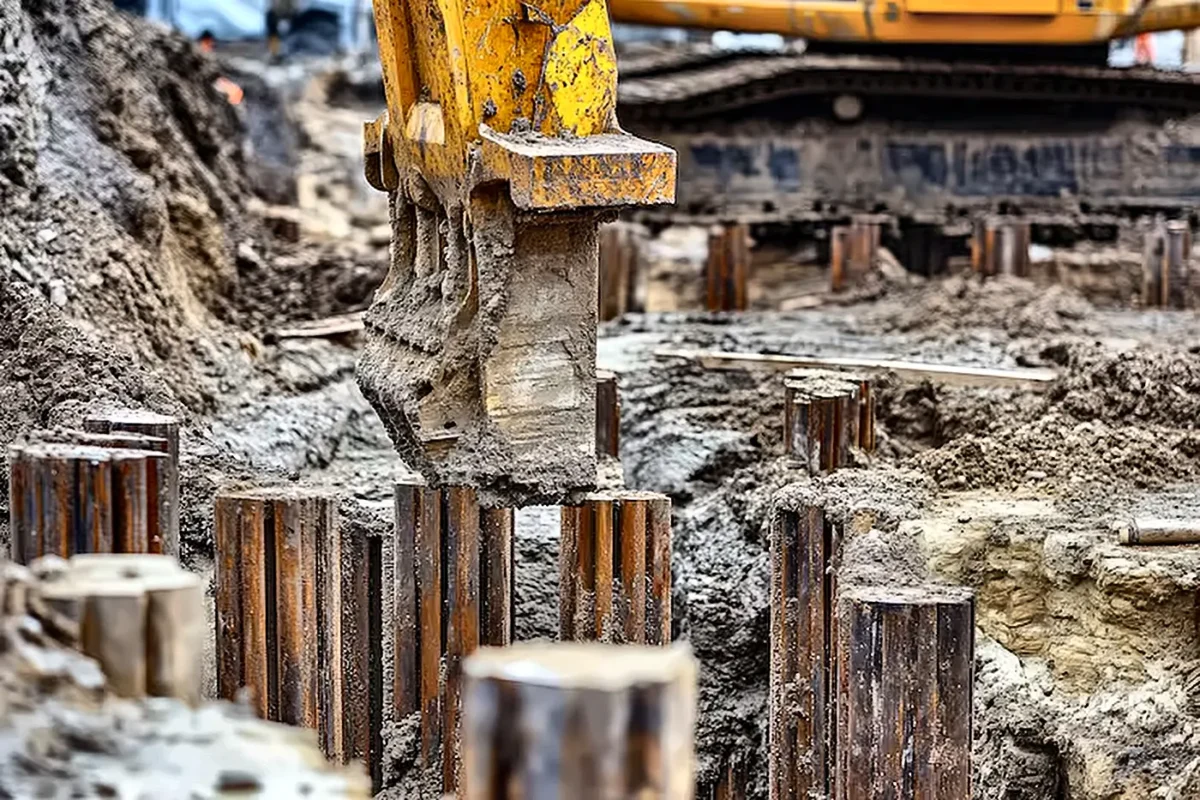
Rather than excavating a large trench and filling it with concrete, a screw pile is mechanically installed into the ground. Its helical sections or helixes, provide bearing and help transfer the weight of the building into the surrounding soil.
Once installed to the required depth and capacity, the piles can be connected using reinforced concrete ground beams, pile caps or specially fabricated steel connections, depending on the construction method being used.
Screw pile systems can therefore provide a foundation solution where conventional shallow foundations may be unsuitable or require substantial excavation.
Why Do House Extensions Need Different Foundation Solutions?
There is no single foundation type that works for every extension.
A foundation needs to be designed around factors such as:
- Soil type
- Ground bearing capacity
- Shrink and swell potential
- Groundwater conditions
- Existing foundations
- Mature trees and their root systems
- The size and weight of the proposed extension
- Site levels and gradients
- Access for excavation equipment
- Nearby buildings and structures
- Underground services
- Local ground conditions
For example, a small rear extension on stable ground may be perfectly suited to a conventional strip foundation. On a property built on highly shrinkable clay with mature trees nearby, however, a much deeper foundation may be required.
This is why a proper site assessment and structural design should always come before deciding which foundation system to use.
Traditional Foundations vs Screw Piles for Extensions
Traditional foundations remain the most common choice for many domestic extensions.
Strip Foundations
Strip foundations consist of continuous concrete footings beneath load-bearing walls. They are relatively straightforward where suitable bearing ground is available at a reasonable depth.
Trench Fill Foundations
Trench fill foundations use concrete to fill much of the foundation trench. This can reduce the amount of below-ground masonry required and can be useful where deeper excavation is necessary.
Raft Foundations
A reinforced concrete raft distributes the building load over a larger area. Rafts can sometimes be considered where ground conditions are weak or variable, although they need to be appropriately designed for the relationship between the existing building and the new extension.
Screw Pile Foundations
Screw piles transfer loads deeper into the ground without requiring the same scale of open excavation as conventional foundations.
They may be considered when traditional foundations would need to become particularly deep or difficult to construct.
The important point is that screw piles are not automatically better than concrete foundations. They are an alternative solution that can become particularly attractive when ground or access conditions make conventional construction problematic.
How Deep Do House Extension Foundations Need to Be?
Foundation depth depends heavily on the site.
There is no universal depth that applies to every UK extension. The foundation needs to reach suitable bearing ground and account for potential movement caused by factors such as moisture changes, frost and nearby vegetation.
Shrinkable clay is particularly important because clay can expand when it becomes wet and contract during periods of drying.
The presence of trees can make this more complicated.
How Trees Can Affect Extension Foundations
Trees can have a significant influence on foundation design, particularly on shrinkable clay soils.
Tree roots can extract moisture from the surrounding soil. During dry periods, this can increase the potential for clay soils to shrink.
Consequently, an extension constructed close to mature trees may require foundations that extend considerably deeper than would otherwise be necessary.
The required depth depends on factors including:
- Tree species
- Tree size and mature height
- Distance between the tree and proposed extension
- Soil type
- Soil shrinkability
- Existing ground conditions
In some situations, a conventional foundation can become impractical because of the depth of excavation required.
A piled solution may provide an alternative route to transferring the building load through unstable near-surface material to more suitable ground.
Tree removal does not necessarily eliminate foundation problems either. Removing a mature tree can allow previously dried clay to rehydrate and expand, potentially creating heave.
Where protected trees are present, additional restrictions may also apply to excavation and root disturbance.
When Are Screw Piles Suitable for a House Extension?
Screw piles may be considered where a conventional foundation would be difficult, disruptive or uneconomical.
Typical situations include:
Shrinkable Clay
Properties constructed on clay soils can experience significant ground movement, particularly where foundations are influenced by trees or changing moisture conditions.
Made-Up or Unstable Ground
Previous construction, demolition, landscaping or land filling can leave areas of made-up ground containing rubble or inconsistent materials.
Where suitable bearing ground is deeper, piling can be considered as an alternative to extensive excavation.
Soft or Variable Ground
Ground conditions can change significantly across relatively small residential plots.
A foundation solution that works at one end of an extension may not be suitable at the other if soil conditions vary.
Restricted Access
Rear extensions can present a practical challenge when there is only a narrow side passage leading to the garden.
Traditional excavation can require larger machinery, spoil storage and concrete deliveries. Screw pile systems can sometimes be installed using more compact equipment, depending on the system and site.
Sloping Gardens
Building an extension on a sloping site can require stepped foundations and considerable excavation.
A piled system can sometimes reduce the amount of earthworks required, although the appropriate solution must be determined by the project engineer.
High Water Tables
Excavating deep foundation trenches in areas with groundwater can create additional construction difficulties.
Piling can sometimes provide an alternative that reduces the need to maintain large open excavations.
Sites Near Trees
Where excavation needs to be minimised around tree roots, a carefully designed piled solution may be worth investigating.
The final foundation design should always take account of arboricultural requirements, structural calculations and any applicable planning or environmental restrictions.
Ground Screws vs Helical Screw Piles
Not every screw foundation system is designed for the same application.
The terms ground screws, helical piles and screw piles are sometimes used interchangeably, but the systems can differ significantly in size, capacity and installation method.
Ground Screws
Ground screws are commonly used for lighter structures.
Depending on the engineered system, they can be suitable for applications such as lightweight extensions, timber structures and other relatively low-load buildings.
FHelical Screw Piles
Helical screw piles are generally designed for higher structural loads.
They can be used for larger extensions and structures involving masonry, steel frames or other heavier construction systems, subject to engineering design.
The correct system should be selected according to the loads, soil conditions and structural requirements of the project rather than simply choosing the smallest or cheapest option.
How Are Screw Piles Installed for a House Extension?
The installation process will vary depending on the piling system, ground conditions and size of the extension, but the process generally follows several stages.
1. Site Investigation
The first step is understanding the ground.
A project may require information about:
- Soil composition
- Ground bearing capacity
- Groundwater
- Existing foundations
- Site levels
- Trees and root zones
- Underground utilities
- Access restrictions
- Potential obstructions
The structural engineer can then determine what the extension is expected to impose on the foundation.
2. Structural and Pile Design
The extension’s structural loads are used to establish the required foundation capacity.
The pile design may determine:
- Number of piles
- Pile spacing
- Pile diameter
- Helix configuration
- Required installation depth
- Required installation torque
- Ground beam or pile cap arrangement
The design should be coordinated with the structural engineer responsible for the extension.
3. Setting Out
The individual pile positions are accurately marked according to the approved foundation layout.
This is particularly important on extensions because the new foundation needs to align correctly with the proposed walls, structural frame and existing building.
4. Installing the Piles
A suitable installation machine drives or screws the piles into the ground.
Additional pile sections can be added where greater depths are required.
Installation data can be monitored, including factors such as torque and depth. This provides useful evidence that the piles have achieved their designed installation criteria.
5. Connecting the Foundation
Once the piles are installed, they need to be connected to the structure.
Depending on the design, this may involve:
- Reinforced concrete ground beams
- Pile caps
- Steel beams
- Fabricated pile heads
- Timber or steel structural frames
The connection is an important part of the overall foundation design and should be detailed by the relevant engineer.
What Are the Benefits of Screw Pile Foundations?
There are several reasons why screw piles may be considered for residential extensions.
Reduced Excavation
One of the biggest potential benefits is reducing the amount of open excavation compared with some traditional deep foundation solutions.
This can be particularly useful in established gardens and restricted sites.
Less Spoil
Because large foundation trenches may not be required, screw piling can reduce the amount of excavated material that needs to be removed from the property.
Useful for Restricted Access
Compact piling equipment can sometimes access locations where conventional excavation machinery would be difficult to use.
The suitability depends on the specific system, access dimensions and site conditions.
Potentially Faster Installation
Screw piles can often be installed relatively quickly once the design and site preparation are complete.
This can help reduce disruption during the foundation stage of an extension project.
Reduced Ground Disturbance
Where deep conventional excavation would be required, a piled solution can potentially reduce the area of soil disturbed.
This may be particularly valuable around established landscaping or trees, subject to the requirements of the project.
Suitable for Challenging Ground
Perhaps the biggest advantage is that screw piles can provide an alternative where shallow foundations are unsuitable because of poor or variable ground.
Are Screw Pile Foundations Cheaper Than Concrete Foundations?
There is no simple answer.
A screw pile foundation may have a higher unit cost than a basic concrete footing, but comparing the two purely on material price can be misleading.
A conventional foundation on good ground may require relatively little excavation and concrete.
However, if an extension requires very deep trenches, extensive spoil removal, specialist excavation, temporary works or large volumes of concrete, the overall cost can increase considerably.
Screw piling may become more competitive when it reduces:
- Excavation
- Spoil removal
- Concrete requirements
- Site preparation
- Labour
- Access requirements
- Construction time
The correct comparison is therefore the total installed foundation cost, rather than simply the price per pile.
Screw Piles and Building Regulations
An extension must comply with UK Building Regulations, regardless of whether it is constructed using traditional concrete foundations or a piling system.
Where screw piles are proposed, building control may require appropriate technical documentation demonstrating that the foundation has been designed and installed to meet the structural requirements.
This can include:
- Structural calculations
- Pile design information
- Installation records
- Torque or depth records
- Load testing where required
- Foundation drawings
- Engineer’s certification or supporting documentation
Requirements can vary according to the project and building control body, so it is sensible to establish what evidence will be required before installation begins.
Do You Need Planning Permission for an Extension With Screw Piles?
The use of screw piles does not by itself determine whether an extension requires planning permission.
Planning requirements depend on the proposed extension and the property, including factors such as:
- Size and position of the extension
- Height
- Relationship to boundaries
- Previous extensions
- Property location
- Conservation-area restrictions
- Listed-building status
- Permitted development rights
Building Regulations are separate from planning permission and both may need to be considered.
If the work involves excavation close to neighbouring buildings, the Party Wall etc. Act 1996 may also become relevant.
Professional advice should be obtained where the proposed foundation works could affect neighbouring structures.
Choosing a Groundworks Contractor for Screw Pile Foundations
The foundation contractor is an important part of the project.
Before appointing a contractor, consider whether they can demonstrate experience with:
- Residential foundations
- Ground investigation
- Screw pile installation
- Difficult access sites
- Foundation design coordination
- Load testing
- Installation monitoring
- Ground beams and pile caps
- Building control requirements
It is also worth asking how the contractor records installation information and how that information will be supplied to your structural engineer and building control.
For wider excavation and groundworks requirements, Dig It Up Groundworks is an example of a UK groundworks specialist that can be considered for projects involving excavation, foundations, drainage, site preparation and other groundwork requirements.
Where screw piling forms part of an extension project, the piling contractor, structural engineer and main builder should work together from the design stage rather than treating the foundation as an isolated part of the build.
Are Screw Piles Right for Your House Extension?
Screw piles are not the solution for every extension.
If your property has stable ground at a relatively shallow depth, traditional foundations may be simpler and more economical.
However, screw piles can become an attractive option where the project involves:
- Difficult clay soils
- Mature trees
- Poor or made-up ground
- Deep conventional foundations
- Restricted garden access
- Sloping sites
- Variable ground conditions
- High groundwater
- Reduced excavation requirements
The key is to assess the ground and structural requirements before choosing the foundation system.
Final Thoughts: Choosing the Right Foundation for Your Extension
The foundation is one of the most important parts of any house extension, even though most of it disappears beneath the finished building.
Traditional strip and trench fill foundations remain excellent solutions for many UK homes. However, challenging ground conditions can make conventional excavation more complicated and costly.
Screw pile foundations for house extensions provide another option worth considering, particularly where deep excavation, poor ground, trees, restricted access or difficult site conditions create problems for traditional foundations.
The right approach is not simply to choose the newest foundation system. It is to select the system that is appropriate for the ground, the building design and the practical conditions of the site.
A qualified structural engineer and experienced groundworks contractor can assess the available options and establish whether screw piles, traditional concrete foundations or another engineered solution is most appropriate.
For homeowners planning an extension, getting the foundation decision right at the beginning can help create a more predictable, efficient and durable build from the ground up.
